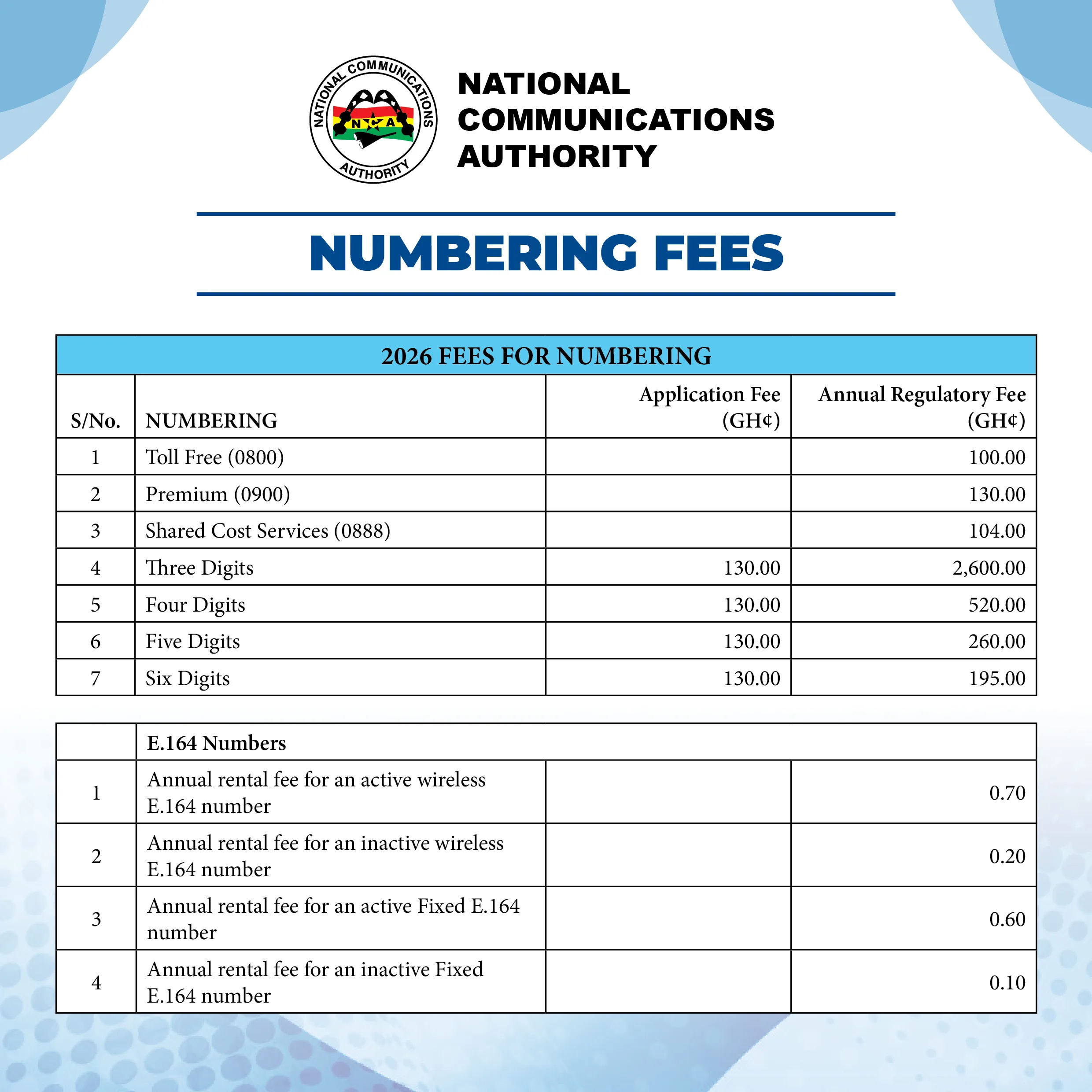
Numbering (SIM, M2M, Short Codes etc.)
Overview
Numbering resources are the numbers, codes and alphanumeric strings used to identify and address subscribers, terminals, networks, network elements, protocols and application services on electronic communications networks. . They allow calls, messages and data sessions to be routed correctly within Ghana and between Ghana and the rest of the world.
The National Communications Authority (NCA) is responsible for the planning, administration, assignment and management of numbering resources in Ghana to ensure their efficient, fair and transparent use. The Authority also safeguards the integrity of the National Numbering Plan and ensures that numbering resources remain available to support innovation, competition and the continued growth of the electronic communications sector.
Pursuant to the Electronic Communications Act, 2008 (Act 775) and the National Communications Authority Act, 2008 (Act 769), the Authority allocates and manages various numbering resources for licensed network operators and authorised service providers.
These resources include, but are not limited to:
- E.164 Numbering Resource
- Geographic Numbering Resource (GNR): Geographic numbers are associated with a defined geographical location within Ghana. so that the digits themselves indicate the general location of the network termination point. These are used principally for fixed electronic communications services.
- Non-geographic numbers are not linked to any specific geographical location. The digits identify a network, a service or a subscription independently of location. Mobile numbers, M2M numbers and special numbering resources fall into this category. The NCA also provides Special Numbering Resources (SNR), which are non-geographic and non-network dependent codes used in sending data and voice. These encompass the following:
- Toll-Free Numbering Resources
- Shared Cost Numbering Resources (SCNR)
- Premium Rate Numbering Resources
- Short Codes
- Network Destination Codes (NDC)
- Mobile Station International Subscriber Directory Number (MSISDN)
- Mobile Network Codes (MNC)
- Machine to Machine Numbering Resources (M2MNR)
-
An E.164 number is a number conforming to ITU-T Recommendation E.164, the international public telecommunication numbering plan. It provides a globally unique address for a subscription on a public network — fixed, mobile or otherwise — and ensures that the number can be reached from any other network in the world. E.164 numbering resources are either Geographic Numbering Resource (GNR) or Non-Geographic Numbering Resource (Non-GNR).
-
Network Destination Codes identify a licensed network operator or a specific range of telephone numbers assigned to that operator. They form part of the national numbering plan and enable the correct routing of communications.
-
An MSISDN is the internationally recognised telephone number assigned to a mobile subscriber. The number consists of a country code (CC) and a National Destination Code (NDC), which identifies the subscriber's operator.
-
The Mobile Country Code (MCC) consists of 3 decimal digits and the Mobile Network Code consists of 2 or 3 decimal digits. The Mobile Network Code (MNC), together with the Mobile Country Code (MCC), uniquely identifies a mobile network operator within international mobile communications networks.
-
Machine-to-Machine numbering resources are dedicated numbering resources assigned to devices that communicate automatically without human intervention, including Internet of Things (IoT) applications, smart utility systems, industrial automation and connected devices.
Technical Information
The Authority’s mandate to establish, administer and manage Ghana’s National Electronic Communications Numbering Plan is provided under Section 65 of the Electronic Communications Act, 2008 (Act 775) and Section 3(w) of the National Communications Authority Act, 2008 (Act 769).
In carrying out this mandate, the Authority develops and maintains the National Electronic Communications Numbering Plan (NECNP), which establishes:
- the structure and format of numbering resources;
- eligibility criteria for the assignment of numbering resources;
- procedures for the allocation, reservation, transfer and withdrawal of numbering resources;
- utilisation and reporting requirements; and
- measures to ensure the efficient and equitable use of numbering resources
Eligibility Criteria
Numbering resources are assigned only to eligible entities in accordance with the Electronic Communications Act, the National Electronic Communications Numbering Plan and any applicable directives issued by the Authority.
Applicants should hold the appropriate licence or authorisation, where required, before applying for numbering resources.
Application Process
Applicants seeking numbering resources should submit:
- a completed Numbering Resource Application Form;
- supporting corporate documentation;
- evidence of the applicable licence or authorisation (where required);
- justification for the requested numbering resource;
- utilisation forecasts; and
- any additional information requested by the Authority during the evaluation process.